
Historically, early-stage founders relied almost exclusively on convertible notes to secure initial funding. However, because these instruments are legally structured as debt, they introduce inherent compliance bottlenecks due to strict maturity dates and accruing interest (Feld & Mendelson, 2019). To alleviate this complexity and friction, a new class of deferred equity agreements was created, the Y Combinator’s Simple Agreement for Future Equity (SAFE) and Keep It Simple Security (KISS); SAFE made its debut in 2013, while KISS first appeared in 2014(Coyle & Green, 2018).
These funding instruments are designed to optimize deal speed and minimize legal overhead. A standard SAFE structurally reduces some of the traditional requirements of debt, completely removing both the maturity deadline and the interest rate (Investopedia, n.d.). This strategic architecture ensures founders are not forced into financial default situation before they can achieve institutional scale. The KISS serves a parallel function but offers a bit more structural flexibility, with some variants intentionally retaining debt-like downside protections to satisfy more conservative early investors (Coyle & Green, 2018).
That being said, founders must approach these agile funding vehicles with strict compliance awareness. While they excel in traditional venture-backed situations, academics warn against their uncalibrated use. For example, deploying SAFEs in the retail crowdfunding space creates a severe operational challenge, heavily disadvantaging novice investors who lack the institutional leverage to ever force a conversion event (Green & Coyle, 2016). Furthermore, relentlessly stacking multiple SAFEs with varying valuation caps can trigger massive, unexpected founder dilution once a priced equity round materializes (Feld & Mendelson, 2019).
By studying the early-stage capital playbook, founders can confidently leverage SAFEs and KISS to bypass initial structural friction and secure vital early-stage runway without inadvertently sacrificing their long-term equity control.
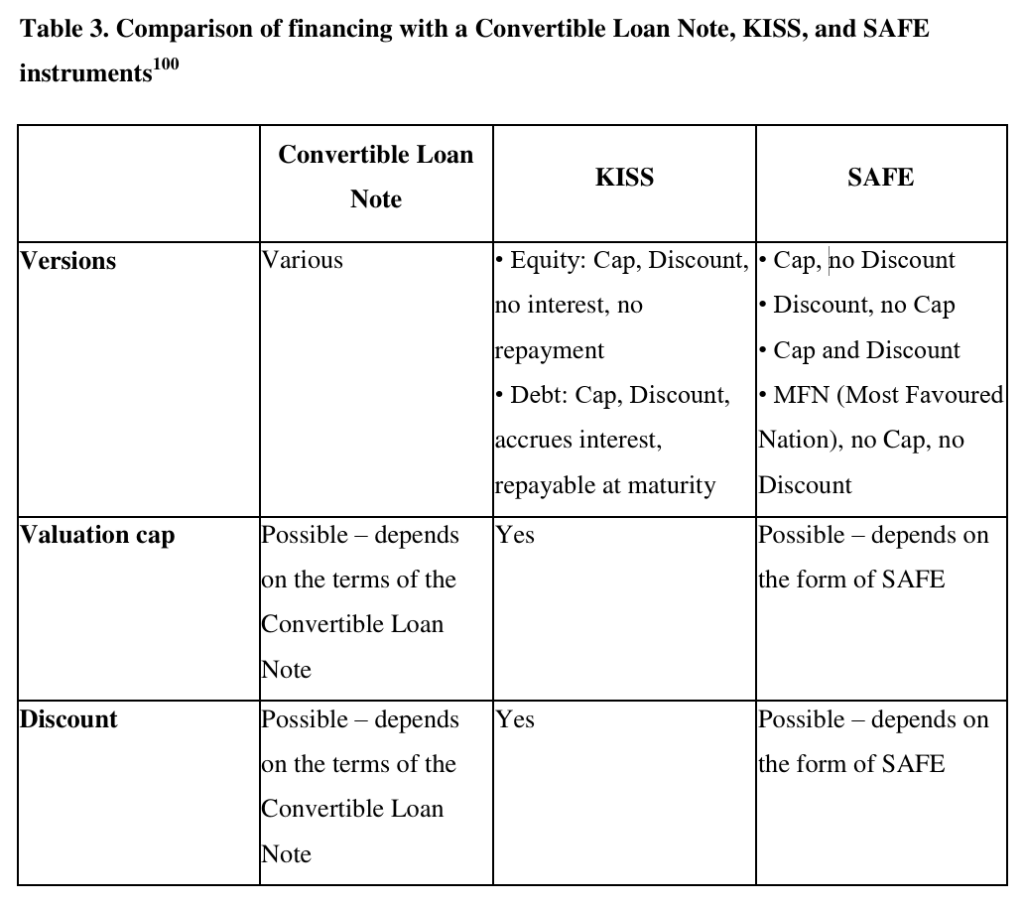
Note: Table 3 from Młodawski’s 2021 thesis, Venture Capital and Equity Crowdfunding – Alternative Sources of Tech Startups Funding
References
Coyle, J. F., & Green, J. M. (2018). The SAFE, the KISS, and the note: A survey of startup seed financing contracts. Minnesota Law Review Headnotes, 103, 42–66.
Feld, B., & Mendelson, J. (2019). Venture Deals: Be Smarter Than Your Lawyer and Venture Capitalist (4th ed.). John Wiley & Sons, Inc.
Green, J. M., & Coyle, J. F. (2016). Crowdfunding and the not-so-safe SAFE. Virginia Law Review Online, 102, 168–182.
Investopedia. (n.d.). Simple Agreement for Future Equity (SAFE). Retrieved from https://www.investopedia.com/simple-agreement-for-future-equity-8414773
Comments
One response to “Seed Financing: Navigating SAFE and KISS”
Toochi,
This was another interesting post because SAFE and KISS agreements are funding instruments I had not heard much about before. At first glance, they seem like an attractive option because they reduce some of the complexity associated with traditional convertible notes and allow founders to raise capital more quickly.
A common theme between the book I’m reading and yours, based on your post, is that there is much more to funding than choosing the easiest one or the method that gives you the most funds. In fact, simplifying funding can lead to complex long-term implications. As you mentioned, founders can unintentionally create significant dilution by stacking multiple SAFE agreements. Entrepreneurs need to understand not only how they are raising capital today, but also how those decisions impact ownership and control in the future.
How do KISS and SAFE agreements differ from venture debt agreements? SAFE and KISS agreements can delay dilution, while venture debt allows founders to raise capital without giving up additional equity. All of these options can be a beneficial funding source depending on the business. Each one solves a different problem, further reinforcing the idea that there is no one-size-fits-all funding strategy.
One question I had while reading your post is about stacking SAFE agreements. You mentioned that founders should be cautious when using multiple SAFEs to avoid unexpected dilution. Is stacking SAFE agreements actually a better strategy than pursuing another form of funding? Also, at what point should a founder transition from SAFE or KISS agreements to a more traditional equity financing structure? There is a point at which the simplicity of these agreements could create more complexity than they save in the long run.